
Summary:
Dragon Mart was originally based in Dubai, United Arab Emirates (UAE) and is the largest Chinese retail and wholesale trading center, as of the mainland of China. It is more than a kilometer long with thousands of stores which stock a wide variety of products, including electronics and homewares, textile, machinery and construction materials.
It has established its own brand as a business-to-business (B2B) and business-to-consumer (B2C) business hub bringing a significant value to the business trade in the region and the economic relations between China and the Middle East. Although no separate Dragon Mart complex in Karachi has a comparable scale, smaller local businesses in Pakistan (e.g. DragonMart.pk shops) use the name to a similar idea of imported goods trade. At the same time, Pakistan is also strategizing its own export hub in Dubai – Pakistan mart – to replicate the presence of Dragon Mart in international trade.
The Background and Development of Dragon Mart in Dubai
Concept and Inception:
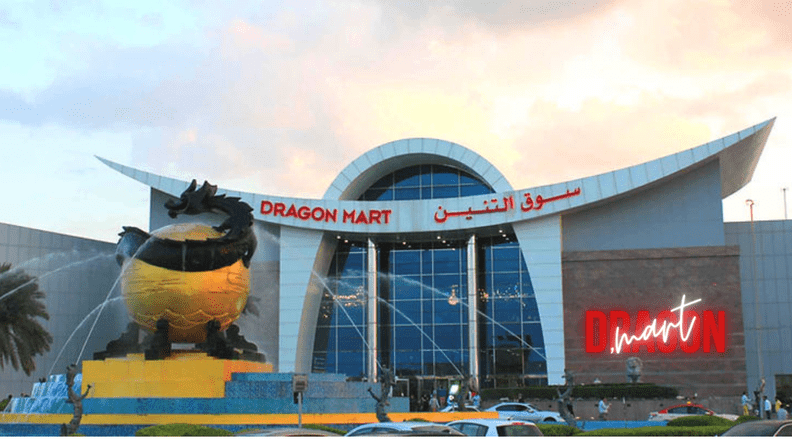
Dragon Mart was the product of a strategic partnership between Dubai Nakheel Properties and Chinese investors (especially Chinamex) to supply Chinese goods to the increasing demand of the gulf and the Middle East in general. The initial stage was opened in December 2004 and its commercial success prompted a second and larger expansion that was completed in 2015. Its architecture: a dragon shaped complex that is approximately 1.2km long represents the Chinese cultural identity and trade aspiration in foreign countries.
Scale and Scope:
Nowadays there are two neighbour hubs (Dragon Mart 1 and 2), and they have thousands of stores that offer a variety of items: household products, furniture, fabrics, electronics, construction materials, toys, clothes, and accessories, and machinery. There are also the eating and recreational facilities of the visitors in the marketplace.
Footfall and Economic Impact:
The complex receives millions of customers per year; the total number of visitors is more than 40 million customers per year, including local inhabitants, expatriates of the United Arab Emirates, and trade buyers all over the Middle East, Africa, and South Asia. This number of visitors shows that Dragon Mart is a great place to shop and wholesale.
The Contribution of Dragon Mart in World Trade
Trade Gateway:
Dragon Mart serves a significant purpose as a point of connection between the manufacturing centres of China and Middle East, African and South Asian markets. It allows buyers to get Chinese products without the logistical hassle of getting them directly in China, thereby lowering the transaction costs and time.
B2B and B2C Ecosystem:
Conventionally used as a B2B platform with SMEs and wholesale purchasers, Dragon Mart is also oriented to retail clients who are interested in diversity and reasonable prices – occupying a specific niche between high-volume buying and consumerism.
Digital Expansion:
In keeping with the trends of digital commerce, Dragon Mart has introduced an e-commerce platform (dragonmart.ae), whereby customers and businesses can browse and place orders of thousands of products online, and options are available that meet retail and commercial requirements. This is a digitally empowered marketplace, which strengthens the status of Dragon Mart as an omnichannel trade hub.
Architecture and Urban Environment
The mall is designed to form a unique shape of a dragon, which spans 1.2 km, not only to serve as a visual representation, but could be used to create a zoned structure of the various product categories. It is a convenient location for freight flow and customer access because it is located in Dubai International City whose logistics network is well established and interconnected with major highways.
Critiques and Challenges
Counterfeit Goods:
Although successful, Dragon Mart has attracted criticism as a venue of counterfeit or unlicensed products, specifically those of electronics, accessories, bags, and such others. This has been enforced against such trade but due to the magnitude of the complex, it has become hard to regulate.
Market Perception:
Different customers complain about different quality and pricing dynamics, whereby the goods are sometimes charged much higher than branded products or regions. This is indicative of changes in the tenant mix as it has evolved over the years, direct manufacture giving way to the traders and intermediaries and reinforces the need for informed purchasing strategies.
The Effect of Dragon Mart on Pakistani Trade and Retail
Local Group Branding of the Dragon Mart:
Locally based companies in Karachi like DragonMart.pk have adopted the Dragon Mart based name to present an analogous model of merchant-shop that deals with imported products and wholesale rates. They are not considered an official expansion of the Dragon Mart in Dubai, but instead small and standalone retailers.
Strategic Response of Pakistan: Pakistan Mart:
On the same line of success of Dragon Mart, the Pakistani officials are considering Pakistan Mart in Dubai. This new hub will be focused on displaying Made in Pakistan products and products such as textiles, surgical equipment, food and others and help in the exportations of these products through the provision of warehouse, show room and e-commerce fulfillment facilities. It is backed by institutions like FPCCI, NLC, and UAE DP World, which highlights a serious initiative at enhancing the international presence of Pakistan in trade.
Perception of the region and strategy
China-UAE Trade Integration:
Dragon Mart serves as a symbol of the strengthening relationship between the China-UAE trade alliance and Dubai as a universal trade center. The geographic location, free trade policy, and logistic facilities of the UAE have placed it at a strategic location in the global supply chains especially among the Chinese manufacturers to the wider Middle East and African markets.
Serving Diverse Buyers:
Small retailers purchasing their supplies to exporters and single shoppers seeking a good deal, define the multi-levels of services that Dragon Mart offers, making it an ecological system that is flexible. It is flexible to new economic changes such as digital retail and facilitation of cross-border trade.
Conclusion
Dragon Mart is a distinctive business establishment, which goes beyond the typical shopping mall purpose. It is a trade hub, a bridge of cultures, and a retail-wholesale hybrid market that has influenced the dynamics of commerce in Dubai, as well as the models of business in the region such as the idea of Pakistan Mart to increase exposure to exports.
In the case of such cities as Karachi, the impact of Dragon Mart is primarily evident in the change of entrepreneurship towards the trade-market oriented model, rather than the physical infrastructure since it is in these hubs that Pakistan has sought to capitalize on the local industry and the international demand.l demand.