For years, corporate offices followed a predictable formula: rows of desks, enclosed meeting rooms, and functional furniture designed primarily for work. Across Dubai, however, that formula is changing. Businesses are rethinking what the workplace should feel like, creating environments that prioritize comfort, wellbeing, flexibility, and memorable experiences alongside productivity.
- The Workplace Experience Has Become a Competitive Advantage
- Reception Areas Are Becoming Destination Spaces
- Comfort Is No Longer an Employee Perk
- Furniture Is Becoming More Residential
- Wellness Is Shaping Workplace Decisions
- Hospitality Principles Improve Client Impressions
- Flexibility Is the New Luxury
- What Dubai’s Workplace Shift Reveals
- Final Thoughts
This shift is particularly evident across Dubai’s business districts, where workplace decisions are increasingly being driven by how people use a space rather than simply how much furniture it can accommodate. Urban 411 Office Furniture, a Dubai-based office furniture supplier and manufacturer, has observed that businesses are spending more time considering how employees collaborate, meet, concentrate, and move throughout the day. The conversation is gradually shifting from simply furnishing an office to creating a workplace that supports the people using it.
The Workplace Experience Has Become a Competitive Advantage
Today’s employees spend a significant portion of their lives at work. As expectations change, companies are paying closer attention to how the physical environment affects productivity, engagement, collaboration, and employee experience.
Rather than designing offices solely around efficiency, businesses are asking more practical questions:
- How can employees feel comfortable throughout the working day?
- How can collaboration happen without disrupting focused work?
- How can the workplace encourage meaningful interaction?
- How can visitors immediately understand the company’s identity?
- How can the office remain useful as the business changes?
Many of the answers are increasingly influenced by hospitality design, where comfort, atmosphere, movement, and experience have always been central considerations.

Reception Areas Are Becoming Destination Spaces
The traditional reception area was often designed around a simple purpose: give visitors somewhere to wait.
That approach is changing.
Many Dubai offices now use reception areas as extensions of the company’s identity, incorporating comfortable seating, warm lighting, artwork, natural materials, greenery, and more relaxed arrangements.
The objective is not simply to make visitors comfortable while they wait. These areas can also function as informal meeting points, conversation spaces, or places where employees can briefly step away from their desks.
This has made the selection of office furniture in Dubai increasingly connected to the wider workplace experience. Seating, tables, storage, and workstations need to work together visually and functionally rather than being selected as isolated products.
Comfort Is No Longer an Employee Perk
Hospitality design has always focused on how people experience a space.
Corporate workplaces are adopting the same principle.
Natural daylight, acoustic privacy, greenery, comfortable seating, and flexible layouts can all contribute to a workplace that feels less rigid and more responsive to different ways of working.
This does not mean turning an office into a hotel. The more useful lesson from hospitality is understanding that comfort and functionality do not have to compete with one another.
A well-designed workplace can be professional while still feeling welcoming.

Furniture Is Becoming More Residential
Another noticeable change is the move away from traditional corporate aesthetics.
Soft textures, timber finishes, rounded forms, neutral palettes, and less visually imposing furniture are increasingly appearing in executive offices, collaboration areas, meeting rooms, and reception spaces.
The objective is not to make offices look like homes. Instead, designers are borrowing selected residential and hospitality principles to make workplaces feel more approachable.
This is particularly relevant in executive environments, where businesses want the office to communicate authority without creating an unnecessarily formal atmosphere.
Wellness Is Shaping Workplace Decisions
Employee wellbeing has become one of the most important considerations in contemporary workplace planning.
Businesses are paying greater attention to posture, movement, lighting, acoustics, privacy, and the ability to change working positions throughout the day.
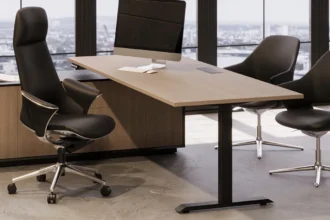
Seating plays an important role in this equation. Ergonomic task chairs can provide better support for employees who spend extended periods working at a desk, particularly when combined with appropriately positioned work surfaces and monitors.
Height-adjustable desks, flexible workstations, and quieter focus areas can complement these choices by giving employees more control over how they work.
The broader lesson is that workplace wellbeing rarely comes from one product. It comes from how multiple elements work together.
Hospitality Principles Improve Client Impressions
Office design influences more than employees.
Clients, investors, suppliers, and business partners can form impressions of an organization from the moment they enter its workplace. The reception area, meeting room, executive office, furniture selection, lighting, and overall sense of order all contribute to that experience.
A thoughtfully designed meeting environment can communicate professionalism without relying on excessive decoration.
This is where hospitality principles become particularly useful. Luxury hotels understand that memorable experiences are created through many small decisions working together. Modern offices can apply the same thinking while maintaining the practical requirements of a professional workplace.
Flexibility Is the New Luxury
Traditional offices were often designed around permanent layouts.
Modern workplaces need to be more adaptable.
Teams expand. Departments reorganize. Working patterns change. Technology evolves. A layout that works perfectly today may become restrictive within a few years.
For this reason, flexibility is becoming an important part of workplace design.
Modular workstations, adaptable meeting areas, movable storage, flexible seating, and multi-purpose spaces allow businesses to respond to change without completely redesigning the office.
The most effective workplace is therefore not necessarily the one with the most impressive furniture. It is the one that can continue working as the organization changes.

What Dubai’s Workplace Shift Reveals
Dubai’s approach to commercial design has always been influenced by architecture, hospitality, retail, and international business.
That cross-pollination is increasingly visible in offices.
A financial company, technology business, professional services firm, or creative agency may have very different operational requirements, but all need workplaces that help people concentrate, collaborate, communicate, and welcome visitors.
This is why the distinction between workplace design and hospitality design is becoming less rigid. Businesses are borrowing the parts of hospitality that improve human experience while retaining the functionality required for professional work.
The result is not necessarily a more luxurious office. It is often a more considered one.
Final Thoughts
Dubai’s offices are moving beyond the idea that a workplace needs to look traditionally corporate to be professional.
The strongest environments combine the discipline of commercial workplace planning with the comfort and human focus associated with hospitality. Furniture, lighting, acoustics, technology, and spatial planning all play a role in creating that balance.
As businesses continue to rethink how and where people work, the office is becoming less about filling a room with desks and more about creating an environment people can use comfortably and effectively. For Dubai’s rapidly evolving business landscape, that shift could make workplace experience an increasingly important part of how companies attract talent, welcome clients, and support long-term growth.